F1 drivers who never won again: 8 last wins, and the contracts signed first
Jean Alesi started 201 Grands Prix and won once. Seven other careers follow the same pattern: the last win came shortly after the driver picked a team for something other than the car.
By The Second GridChecked against 34 sources (9 primary)Updated
7 min read · 11:28 video
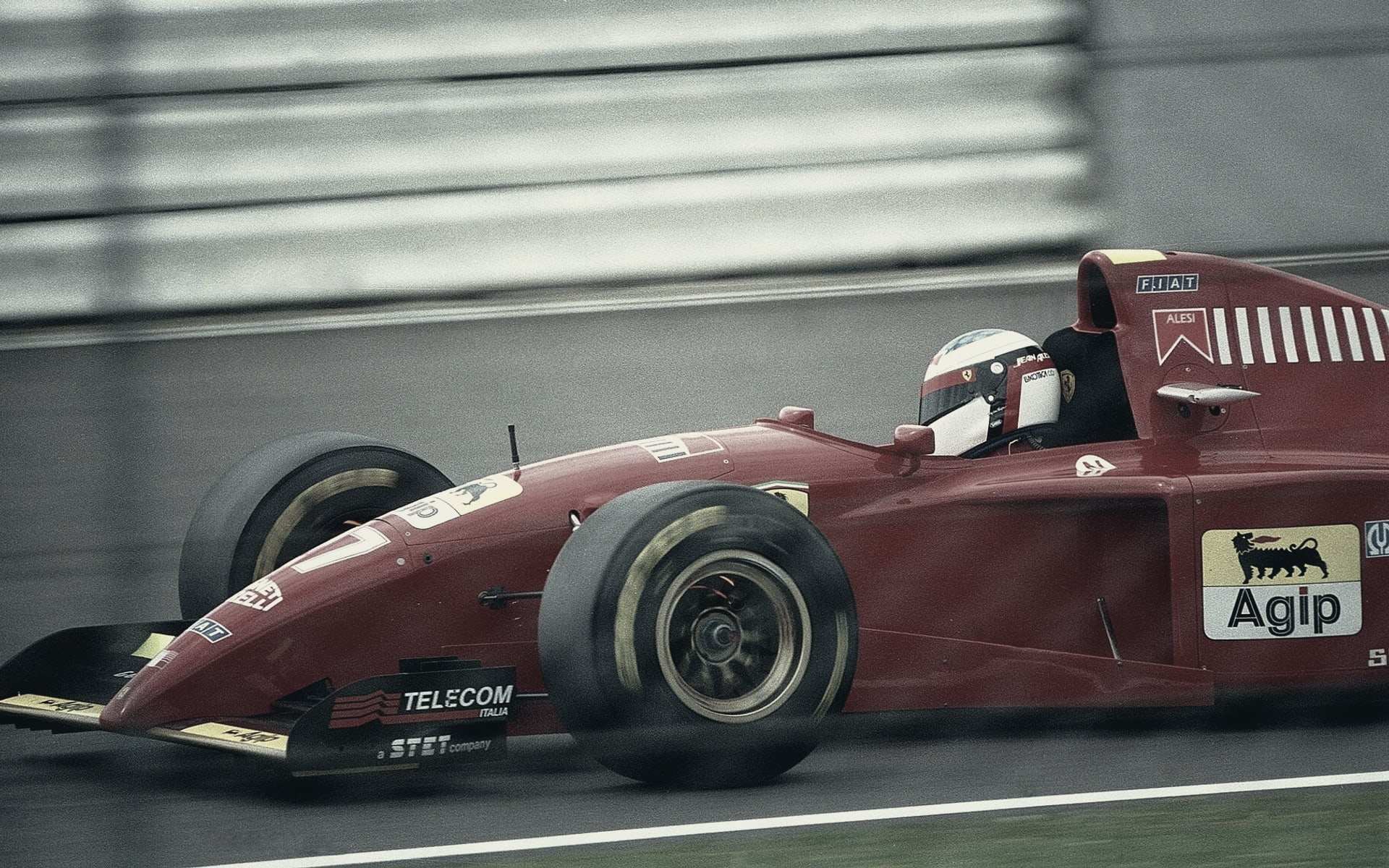
Jean Alesi, Ferrari 412T2, 1995 British Grand Prix. Photo: Martin Lee, CC BY-SA 2.0, via Wikimedia Commons; colour-graded and cropped by The Second Grid; this adaptation is licensed CC BY-SA 2.0.
Jean Alesi started 201 Grands Prix and won 1 of them, in the wet at Montreal in 1995. He was on the podium 32 times across 13 seasons, and he shares the record for the most podiums before a first win (Motor Sport).
It’s easy to say he just wasn’t quick enough. The record points somewhere else, to a Williams contract he gave up at the end of 1990. The same sequence runs through 7 other careers.
Alesi had already signed for Williams
At the end of 1990 Alesi had a signed Williams contract for the following season. Then Ferrari decided it wanted him and bought him out of it, with a payment to Frank Williams and a Ferrari car. Joe Saward identifies the car as a 641 chassis, handed to Williams to settle the contract.
1992 constructors’ championship: the team Alesi signed for, and the one he chose
| Pos | Team | Pts |
|---|---|---|
| 1 | Williams Renault | 164 |
| 2 | McLaren Honda | 99 |
| 3 | Benetton Ford | 91 |
| 4 | Ferrari | 21 |
Source: Formula 1 — 1992 Teams’ standings
Alesi took the Ferrari. Almost anyone would have.
Williams won the constructors’ championship in 1992 and again in 1993, with Nigel Mansell and then Alain Prost winning the drivers’ title. Ferrari finished 4th in both years.
This piece looks at 8 drivers and 8 dated last wins. In every case, the last win came shortly after the driver picked a team for something other than the car.
Nobody signs for the slower car
When Alesi signed, nobody saw Ferrari as the slower seat. He was joining the team he had wanted to drive for since he was a boy. Charles Leclerc gave the same reason when he re-signed with Ferrari in 2026.
The Ferrari 641 is now in the collection of the Museum of Modern Art. Part of what Ferrari paid for Alesi was a car that a museum later collected as a piece of design.
Then the order flipped. The competitive picture changed over one winter, in factories Alesi had no access to, on decisions taken by people he would never meet. A choice that was right on the day he made it had stopped being right a few months later.
One case on its own could be bad luck. The same sequence shows up 8 times across 40 years.
They chose what they could count
When it came to signing, each of these drivers went for something he could measure.
1976 drivers’ championship: the McLaren Fittipaldi left, and his own team
| Pos | Driver | Team | Pts |
|---|---|---|---|
| 1 | James Hunt | McLaren Ford | 69 |
| 2 | Niki Lauda | Ferrari | 68 |
| 16 | Emerson Fittipaldi | Fittipaldi Ford | 3 |
Source: Formula 1 — 1976 Drivers’ standings
In 1976 Emerson Fittipaldi left McLaren as the reigning runner-up, with 2 titles and 14 wins behind him. He joined the Copersucar-backed team owned by his brother Wilson. “I was taking a risk, it’s true,” he later said.
His last win stayed the 1975 British Grand Prix. In his first season with the family team he finished 16th, with 3 points. His best result there was 2nd at the 1978 Brazilian Grand Prix, and he stopped driving after 1980.
For 1988 Nelson Piquet followed an engine. Honda was leaving Williams, so the 3-time world champion went where Honda went, to Lotus. But Honda also went to McLaren, and Lotus got the lesser package. Piquet had picked the right engine and the wrong team to get it through.
He did win again, later and elsewhere, with his last victory at the 1991 Canadian Grand Prix. He never added to his 3 titles.
In 2005 Ralf Schumacher followed the money. Williams wouldn’t pay his fee and Toyota would, at a reported $12m to $16m a year. The deal was later described as the team’s worst single decision. His last win had come at the 2003 French Grand Prix.
None of those was a stupid thing to want. A brother’s team, an engine deal and a salary can all be measured on the day you sign the contract.
Signing on last season’s results
The problem is that everything you can measure on signing day is about the past. None of it tells you what next year’s car will do.
Villeneuve’s last win: 1997 Luxembourg Grand Prix
| Pos | Driver | Team | Gap |
|---|---|---|---|
| 1 | Jacques Villeneuve | Williams Renault | — |
| 2 | Jean Alesi | Benetton Renault | +11.770 s |
| 3 | Heinz-Harald Frentzen | Williams Renault | +13.480 s |
Source: Formula 1 — 1997 Luxembourg Grand Prix: race result
Daniel Ricciardo signed for Renault on 3 August 2018. The appeal was a seat where he wasn’t Max Verstappen’s team-mate. That was a real problem, judged on real results, all of which had already happened. He won once more, at Monza in 2021. In 2024 he was dropped with 6 rounds still to run.
Fernando Alonso left Ferrari a year early to drive McLaren’s Honda-powered car, with an engine that didn’t exist yet. He had no performance data to go on, just the name and a plan. At publication in August 2026, his last Grand Prix win was still the Spanish Grand Prix on 12 May 2013, his 32nd.
Jacques Villeneuve held the strongest hand of anyone here. He was the 1997 world champion with 11 wins, the last of them at the Luxembourg Grand Prix on 28 September 1997.
He left Williams for a new team run by his own manager, Craig Pollock, and by his own later account he turned down an offer from McLaren to do it. The move was announced on 23 July 1998. British American Racing failed to score a point in 1999, and Villeneuve retired from each of the first 11 races. He never won again.
An early sign of what he had joined was the livery. BAR wanted to run its 2 cars in 2 different sponsors’ colours, Lucky Strike and 555. The FIA objected that a team’s cars should look substantially alike, so BAR split every car down the middle, with one livery on each side and a zip painted between them. It was a clever fix for a problem nobody else had, on a car that scored nothing.
Robert Kubica’s case is different, but it makes the same point from the other side. He won the 2008 Canadian Grand Prix. In February 2011, between seasons, he entered a small rally in Italy and a barrier came through the cockpit. It took more than an hour to free him.
He suffered 42 fractures and a partial amputation of his right forearm, and needed a 12-hour operation. He had a signed Ferrari deal for 2012 and never drove it. He didn’t choose badly. An off-season rally is a normal thing for a racing driver to do. He’s on this list because nobody in F1, driver or team, gets to see what happens next.
8 titles before the decisions, 5 wins after
The fair way to judge a decision is to look at what the driver turned down, and what that seat did next.
The Williams Alesi was contracted to drive won both championships in 1992 and both again in 1993. The McLaren Villeneuve turned down won the drivers’ title in 1999, his first season away from Williams. The Red Bull seat Ricciardo left won 4 straight drivers’ championships from 2021.
The McLaren Fittipaldi walked away from won the drivers’ title in 1976, the very next year. And the Ferrari Alonso left a year early won 3 races in 2015, 3 more than the McLaren he joined.
None of that proves anything about the drivers who left. Each of those cars was driven and developed around someone else, in a season that had moved on, so you can’t hand the results to the man who said no.
Put Alesi in the 1992 Williams and you haven’t run an experiment. You’ve written fan fiction with a spreadsheet attached.
What you can do is count. When they made their decisions, these 8 drivers held 8 world championships between them: Fittipaldi 2, Piquet 3, Villeneuve 1, Alonso 2. Across every season after those decisions, all 8 of them combined won 5 races: 3 for Piquet, 1 for Alesi and 1 for Ricciardo.
One driver breaks the pattern. Juan Pablo Montoya left Formula 1 for NASCAR in 2006. He has said he left no unfinished business in F1 and had stopped enjoying himself at McLaren. He went on to win the Daytona 24 Hours 3 times and the Indianapolis 500 again in 2015.
Leaving him out would make the pattern look stronger than it is. It’s a pattern with exceptions, and Montoya is one of them.
A record only lists the seat he took
A driver’s record doesn’t list the seats he was offered, only the one he took. That makes it an odd document. It looks like a measure of the driver, yet a good part of it is measuring a guess.
Alesi’s only win: 1995 Canadian Grand Prix
| Pos | Driver | Team | Gap |
|---|---|---|---|
| 1 | Jean Alesi | Ferrari | — |
| 2 | Rubens Barrichello | Jordan Peugeot | +31.687 s |
| 3 | Eddie Irvine | Jordan Peugeot | +33.270 s |
Source: Formula 1 — 1995 Canadian Grand Prix: race result
Look at when those guesses get made. Ricciardo signed on 3 August, and Villeneuve’s move was announced on 23 July. Drivers commit in the summer, around the time most people are choosing where to go on holiday, to a car that won’t turn a wheel until the following winter.
They are buying the factory’s next car, and the only evidence on the table is how its last one turned out. That’s why the measurable things keep losing. Money, billing and engine badges all matter, but they all reflect last season, and the driver is signing up for the next one.
Asked in 2026 whether he made a mistake in saying no to Williams, Alesi answered: “Maybe. But I’d made my decision because of human issues, not car issues.”
Nobody signing a contract at the end of 1990 could have known what the 1992 Williams would be. Getting that call right was mostly down to luck.
Key facts
| Jean Alesi, career | 201 starts, 1 win, 32 podiums (1989–2001) |
|---|---|
| Ferrari’s buyout of Alesi’s Williams deal | A payment plus a Ferrari 641 chassis |
| Villeneuve’s last win | 1997 Luxembourg GP, 28 September 1997 (his 11th) |
| Villeneuve’s BAR move announced | 23 July 1998 |
| Ricciardo signs for Renault | 3 August 2018 |
| Ralf Schumacher’s Toyota fee | Reportedly $12–16m a year |
| The eight, combined | 8 world titles before their decisions, 5 race wins after |
Sources (34 · 9 primary, marked ●)
- ● 1992 Teams’ standings — Formula 1
- ● 1993 Teams’ standings — Formula 1
- ● 1995 Canadian Grand Prix: race result — Formula 1
- ● 1975 British Grand Prix: race result — Formula 1
- ● 1976 Drivers’ standings — Formula 1
- ● 1991 Canadian Grand Prix: race result — Formula 1
- ● 2003 French Grand Prix: race result — Formula 1
- ● 1999 Drivers’ standings — Formula 1
- ● 1997 Luxembourg Grand Prix: race result — Formula 1
- Jean Alesi — Wikipedia
- Jean Alesi’s only F1 win in a 13-year career of hard-luck stories — Motor Sport Magazine
- Alternative histories: What if Jean Alesi had gone to Williams and not Ferrari? — Formula 1
- The nearly man — grandprix.com
- Formula 1 Racing Car (641/2), 1990 — The Museum of Modern Art
- ‘I began to cry inside my helmet’: Jean Alesi recalls his only F1 win, 31 years on — Motor Sport Magazine
- Emerson Fittipaldi — McLaren
- Fittipaldi and Copersucar — Motorsport Retro
- Piquet and Honda — Honda Global
- How Toyota got it wrong — RaceFans
- Daniel Ricciardo quits Red Bull for Renault — Sky Sports
- Daniel Ricciardo’s RB exit confirmed as Liam Lawson gets seat for remaining six rounds of 2024 — Sky Sports
- On this day in 2013: Fernando Alonso’s last F1 win — PlanetF1
- Fernando Alonso’s career choices: the good, the bad and the ugly — Sky Sports
- Villeneuve takes his final win after Schumacher brothers collide — RaceFans
- The remarkable Jacques Villeneuve and his career-wrecking F1 decision — Motor Sport Magazine
- Jacques Villeneuve formally announces BAR for 1999 — Atlas F1
- Villeneuve reveals F1 career mistakes — grandprix.com
- Jacques Villeneuve: driver profile — Crash.net
- BAR’s new split personality — grandprix.com
- The horrifying crash that ended Robert Kubica’s Ferrari dream — RacingNews365
- Robert Kubica relives rally accident: 42 fractures, 12-hour operation — PlanetF1
- Montoya: no unfinished business in F1 — Autosport
- Montoya looking forward to challenge of IndyCar — IndyCar
- Montoya nets $2.4 million for Indy 500 victory — IndyCar
Spotted an error? Email contact@thesecondgrid.com with your source. Confirmed fixes go on the corrections log.
Shorts on this story — open on YouTube
Read next
All articles
Drivers
Charles Leclerc’s Ferrari gamble: why he signed again after 7 seasons without a title
Charles Leclerc signed with Ferrari again on 3 June 2026, after 7 seasons without a title. He crashed out at Monaco 4 days later and won Silverstone a month after that.
5 min read · 14:09 video
History
6 F1 what-ifs, and why 3 of them lead back to one factory in Brackley
Hamilton’s signature, Brawn’s £1 team, Rosberg’s 5 days, Verstappen’s promotion, 1 point in 2007 and Imola 1994. Half of them lead back to the same building in Brackley.
7 min read · 12:15 video
Business
How much does it cost to reach F1? A ladder that bills you for winning
Winning Formula 3 pays €300,000. The Formula 2 season it has to be spent on costs €2–3 million, and the Super Licence points table means skipping that season is not an option.
6 min read · 18:16 video