How strong is the F1 halo?
The F1 halo has to survive a load of 140 kN, about the weight of 14 tonnes, pressed onto it for 5 seconds without the chassis or its mountings failing. That is the 2026 rule. When the halo became compulsory in 2018 the figure was 125 kN, which the FIA described as 12 tonnes. The part itself weighs about 7 kg.
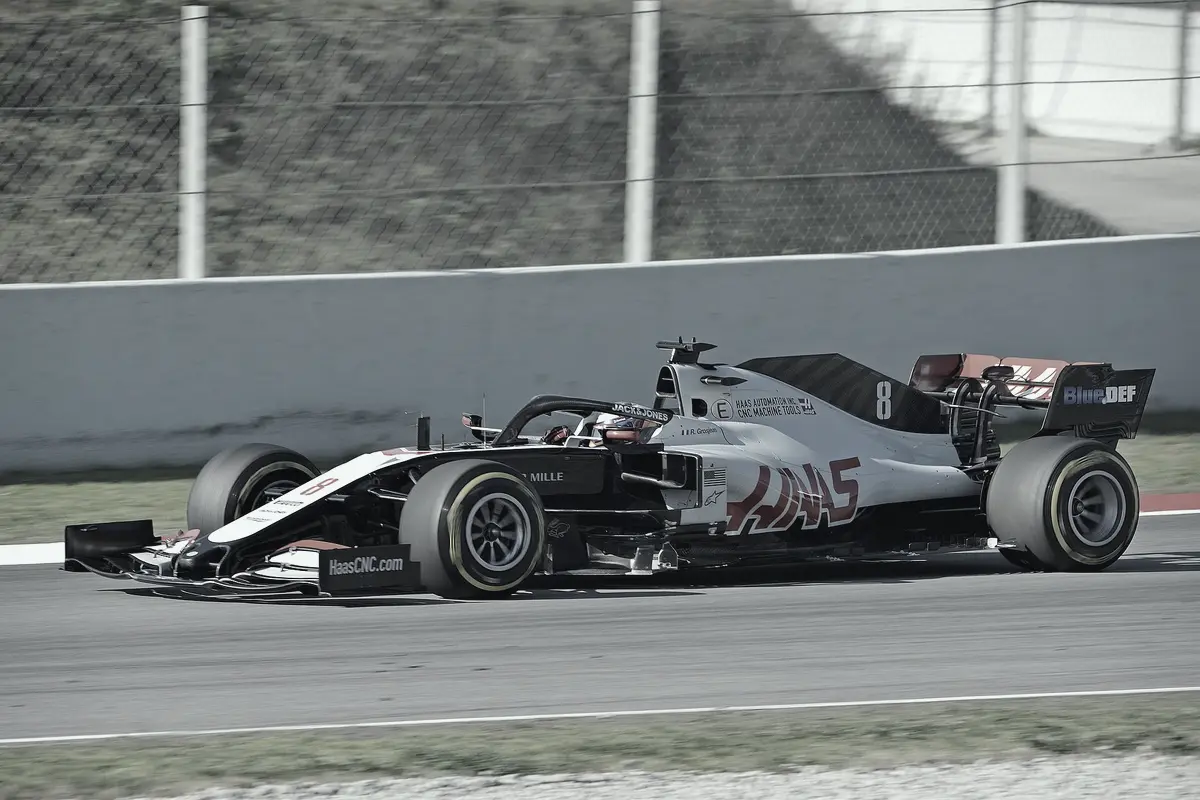
Romain Grosjean, Haas VF-20, pre-season testing in Barcelona, February 20, 2020.
Photo: Alberto-g-rovi, CC BY 3.0, via Wikimedia Commons; colour-graded and cropped by The Second Grid.
What the load test asks for: how much the halo must hold
The halo is a titanium hoop on 3 mounts: a single pillar in front of the driver and 2 legs either side of the cockpit behind them. The rulebook calls it the Secondary Roll Structure. It has to be made to the FIA standard 8869-2018 by a manufacturer the FIA has appointed, so teams fit the halo but don’t design it (FIA 2026 Technical Regulations, C12.4.2).
The 2 static tests in the 2026 rules. A pad presses on the top of the hoop near the front, then on its side; each load must be held for 5 seconds with no failure of the survival cell or the halo’s mountings.
Source: FIA 2026 F1 Regulations, Section C (Technical), Issue 20, Article C13.3.2
The test itself is in Article C13.3.2, and there are 2 parts. In the first, a 150 mm pad presses on the top of the hoop near the front, with 130.1 kN downwards and 51.6 kN rearwards. In the second, the pad pushes on the side of the hoop with 104.5 kN inwards and 93.2 kN rearwards. Each pair adds up to 140 kN. The peak has to be reached within 3 minutes and held for 5 seconds, and afterwards no part of the survival cell, and none of the attachments between it and the halo, may have failed.
A team can apply the full 140 kN on a test rig. Or it can run a physical test to a lower load and show by calculation that the mountings would survive 168 kN, which is 120% of the test load.
So this is a test of the chassis as much as of the hoop. A titanium bar is only as strong as the carbon it’s bolted to. When the halo arrived, Mercedes technical director James Allison said his team had to strengthen its chassis to take “roughly the weight of a London double decker bus sitting on top of the halo” (Formula1.com).
From 12 tonnes to 14
The 2018 version of the test used 116 kN down and 46 kN rearwards on top, and 93 kN in and 83 kN rearwards from the side (Pitpass, publishing the FIA’s test). Both come to about 125 kN. The FIA’s own summary called that “equivalent to 12 tonnes in weight” (FIA).
Load on the halo, kN
Source: FIA Spa 2018 investigation via f1i; FIA (2018); FIA 2026 Technical Regulations, C13.3.2
Strictly, 125 kN is the weight of about 12.7 tonnes, and 140 kN about 14.3. The 12-tonne figure was the 2018 pass mark, a minimum, not the point where the halo breaks. We couldn’t establish in which season between 2018 and 2026 the load was raised. The current rulebook simply states 140 kN.
The test loads are deliberately higher than anything measured in a race. At the start of the 2018 Belgian Grand Prix, Fernando Alonso’s McLaren was launched over Charles Leclerc’s Sauber and left tyre marks on the halo. The FIA’s investigation estimated the peak force on it at 58 kN, “46% of the 125kN FIA prescribed load requirement” (f1i).
About 7 kg of titanium nobody asked for
The structure is Grade 5 titanium, an alloy used widely in aerospace for its strength and stiffness relative to its weight. The FIA chose 3 manufacturers to make it for 2018 (FIA). The finished part weighs about 7 kg (Formula1.com). Teams are allowed to add aerodynamic fairings to it, but not to change the structure.
Mass of the halo
≈7 kg
Grade 5 titanium, an aerospace alloy, made by FIA-appointed manufacturers to the standard FIA 8869-2018. Teams may add their own aerodynamic fairings.
Source: FIA, “How to make an F1 halo” (2018); Formula1.com (February 8, 2018); FIA 2026 Technical Regulations, C12.4.2
Hardly anyone in the paddock liked the look of it. In July 2016 the teams voted against bringing it in for 2017, and the FIA put it back a year (Sky Sports). The drivers were split: the FIA said early in 2017 that opinion among the 16 who had replied was “divided 50/50” (Motorsport.com).
Some objections were blunt. “I am against every Halo or Shield or whatever, it is not F1,” Romain Grosjean said in July 2017 (RaceFans). At Mercedes’ launch in February 2018, Toto Wolff said: “If you give me a chainsaw, I would take it off” (Motorsport.com).
Bahrain 2020: the barrier that reached the halo
On the first lap of the Bahrain Grand Prix on November 29, 2020, Grosjean’s Haas left the track and hit the barrier at 192 km/h. The FIA’s investigation measured a peak of 67 g. The car went through the triple guardrail, split in two and caught fire, and Grosjean was out of it 27 seconds after the impact (Sky Sports).
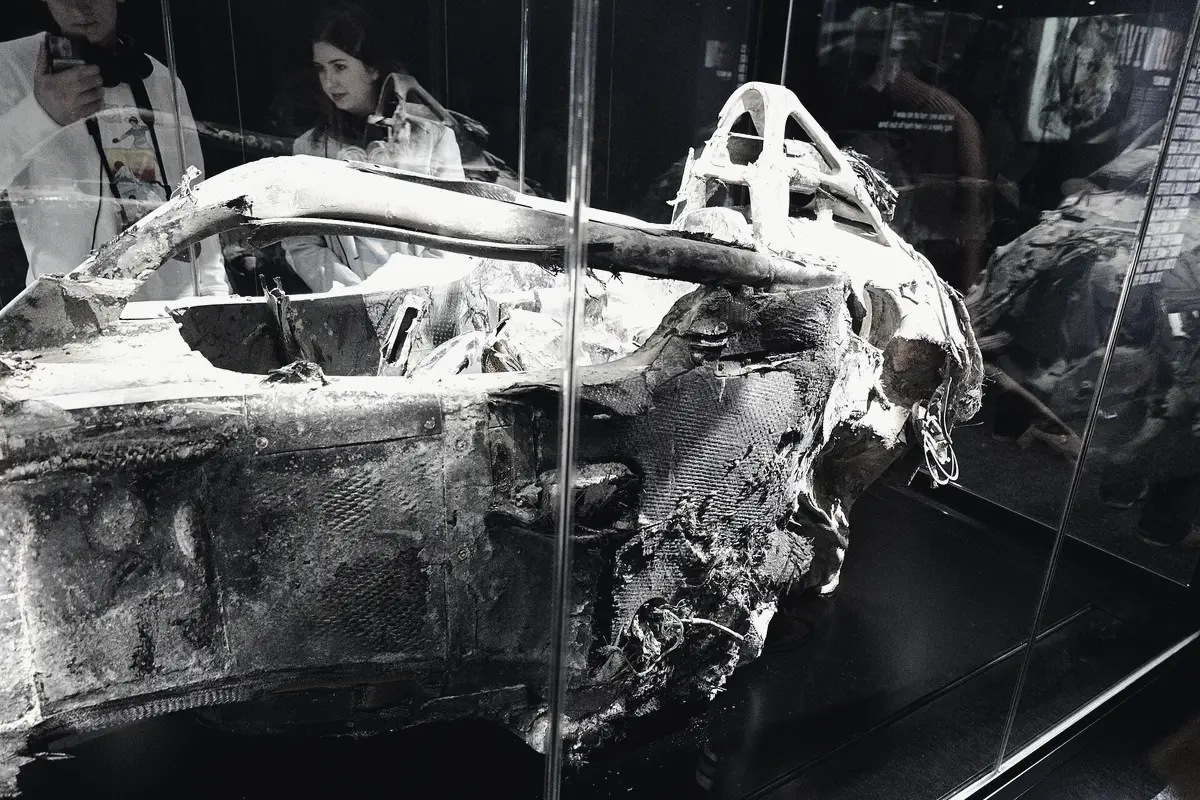
The survival cell of Romain Grosjean’s Haas VF-20 from the 2020 Bahrain Grand Prix, with the halo still in place, at the Formula 1 Exhibition in London in 2025.
Photo: Hullian111, CC BY-SA 4.0, via Wikimedia Commons; colour-graded and cropped by The Second Grid (this adaptation is licensed under the same licence).
The FIA found that the helmet, HANS device, harness, survival cell, seat, headrest and halo had all “performed as expected”. The halo was one of several systems doing its job that day, and its job was to keep the steel barrier away from his head. Grosjean, speaking from hospital, put it his own way: “I wasn’t for the halo some years ago… without it I wouldn’t be able to speak to you today” (Formula1.com).
The case for it has only grown since. At Monza in 2021, Max Verstappen’s Red Bull came to rest on top of Lewis Hamilton’s Mercedes, and Hamilton said afterwards: “Thank God for the halo” (ESPN). In the 2026 rules it’s still compulsory on every car, made to the same 2018 standard and tested to a higher load than the one it launched with.
Questions people also ask
- How much does the F1 halo weigh?
- About 7 kg, according to Mercedes when the halo was introduced in 2018. It is a single titanium structure.
- What is the F1 halo made of?
- Grade 5 titanium, an alloy widely used in aerospace. It is made by manufacturers the FIA appoints, to the FIA standard 8869-2018, so teams fit the halo but do not design it.
- When did F1 introduce the halo?
- It became compulsory from the 2018 season. The teams had voted in July 2016 against bringing it in for 2017.
Key facts
| Compulsory since | The 2018 season, on every F1 car |
|---|---|
| Material and mass | Grade 5 titanium, about 7 kg |
| 2018 test load | 125 kN from above, which the FIA called “equivalent to 12 tonnes”, held for 5 s |
| 2026 test load | 140 kN in each of 2 load cases (Article C13.3.2), about 14 tonnes |
| Spa 2018 | Estimated peak of 58 kN on Leclerc’s halo, 46% of the 125 kN requirement |
| Bahrain 2020 | Grosjean hit the barrier at 192 km/h, peak 67 g; out of the car 27 s after impact |
Sources (12, 2 primary, marked ●)
- ● 2026 F1 Regulations, Section C (Technical), Issue 20 (August 5, 2026), Articles C12.4.2 and C13.3.2, FIA
- ● How to make an F1 halo (March 13, 2018), FIA
- FIA reveals Halo test process (September 22, 2017), Pitpass
- Halo strong enough to hold a bus, say Mercedes (February 8, 2018), Formula1.com
- Formula 1 votes against halo in 2017, Sky Sports
- FIA still working on halo despite split opinion from F1 drivers, Motorsport.com
- Wolff would take a chainsaw to the halo, Motorsport.com
- F1 Fanatic round-up, July 15, 2017 (Grosjean on the halo and Shield), RaceFans
- FIA investigation into Spa crash reveals Leclerc’s vital luck, f1i
- Romain Grosjean accident findings published by FIA (March 6, 2021), Sky Sports
- Grosjean describes halo as ‘greatest thing’ from hospital bed, Formula1.com
- Lewis Hamilton: Halo saved my life in Max Verstappen crash (Monza 2021), ESPN
Spotted an error? Email contact@thesecondgrid.com with your source. Confirmed fixes go on the corrections log.